
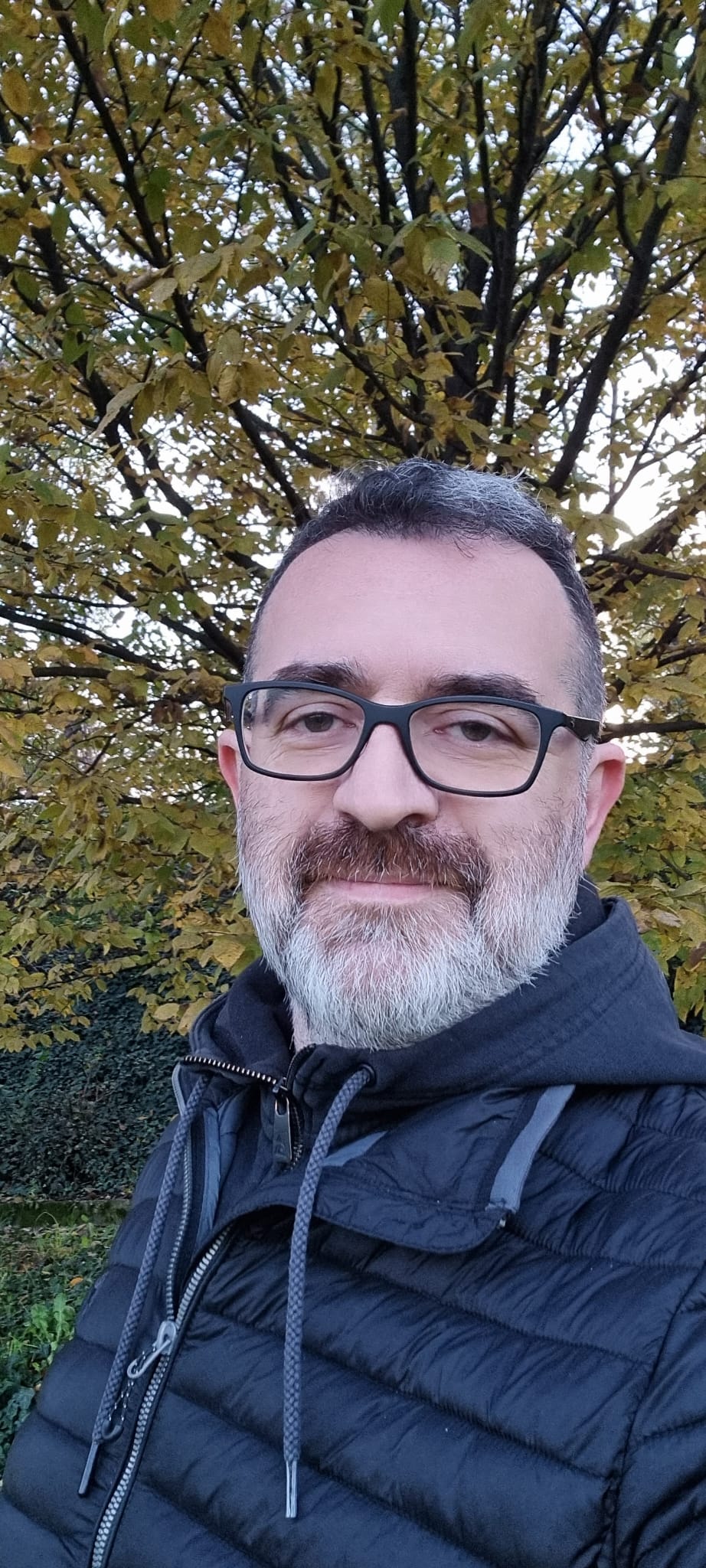
My name is Edoardo Luca Radice. I was born in Saronno on 20 July 1969 — fifteen minutes before Neil Armstrong uttered the famous words “Houston, Tranquility Base here. The Eagle has landed”.
I earned my degree in General Physics at the University of Milan, with a thesis on X-ray emission in compact clusters of galaxies. I describe myself as a non-practising astrophysicist: in Italy, pursuing an astrophysics career is difficult, especially in the early years, and it demands sacrifices I was not willing to make. So I chose to make physics and astronomy a serious hobby and to devote myself to another profession. Astronomy, however, has never been one interest among many to me: I have no memory of becoming fascinated with the sky, because the sky has always been with me.
I have been photographing the stars for over forty years. I began at thirteen with my father’s old film camera — a fixed lens and no knowledge whatsoever: my first photograph was the streak of the Moon rising behind the neighbour’s house. I grew up with analogue photography, when it meant spending forty-five minutes at the eyepiece, with the illuminated reticle, manually guiding on a star to obtain an exposure that today takes a few seconds. I do not miss that toil in the slightest, but I am convinced that what I learned back then — exposure times, planning, framing — retains its full validity: the medium changes, but you are always capturing photons, and the underlying principles stay the same. It is this continuity that eased my transition from analogue to digital.
Today I devote myself mainly to the processing of astronomical images with PixInsight, for which I am an official contributor and Ambassador. I give lessons and workshops throughout Italy and follow the Italian community devoted to the software. I took part as a speaker at CEDIC in Linz, Austria, in its 2019 and 2024 editions, and I contributed to the development of the photometric colour calibration tools (PCC and, later, SPCC) and of the gradient-correction tools — the latter born, in fact, to process my own images taken under a difficult sky, within the Messier @ Home project.
My vision of astrophotography
To me, an astrophotographer is someone who photographs the night sky with a conscious understanding of the process. This means knowing what would happen if the automation were switched off — not because it is necessary to do so, but because the underlying knowledge guides the technical choices. Automation is a legitimate means; what matters is not delegating one’s thinking to it.
True competence lies in recognising a galaxy, an emission or reflection nebula, and understanding the physical principles that determine them. These same principles — accessible at the secondary-school level — inform decisions about equipment and processing.
Smart telescopes represent a trend that worries me, not because of the technology in itself, but because of the philosophy behind it. Remote operation and automation can be useful tools — indeed, it is valid to be able to manage your equipment from a place with a better sky. What I criticise is the model in which the final result is the only thing that matters, while the entire intermediate process — acquisition, calibration, understanding the data — is treated as an obstacle. In this approach, to obtain a result you need to know not more, but less.
The diversity of astrophotographic results should be understood, not flattened.
Colour as a document
When it comes to colour, I consider myself a purist. I believe that in astronomy colour must carry documentary value, a precise meaning. From the very start I was won over by the philosophy of PixInsight, its chromatic agnosticism: assuming a sufficiently large population of stars, which is globally white, and using it as the reference for balancing. This yields a calibration that is as objective as possible — a term that does not equate to “right”, but to shareable: two similar setups return comparable results, and the image tells something real about the object, not merely something photogenic. It is not about making results uniform, but about bringing out their differences from a common white point.
Where the name L’Arciere Celeste comes from
Until a few years ago I practised archery, in the field archery discipline: a style of shooting that takes place in contact with nature, along courses traced through the woods. My favourite bow was the classic wooden recurve, with no sight or other “gadgets” — the essential, and nothing more. From that passion, and from the sky that has always been with me, comes the name L’Arciere Celeste (The Celestial Archer).
Why I do it
What drives me most, in recent years, is sharing an idea of astrophotography — and that is what I try to do in my courses, where I do not limit myself to teaching the use of a piece of software. There is no “recipe”: there is a basic method, but every image must be understood and processed accordingly. I try to observe the world through the physical laws that govern it. I like to say that I am a physicist not because I studied physics, but I studied physics because I am a physicist. This is the way of looking that I try to pass on, and it is the reason I keep photographing the sky.
On this website you will find tutorials, articles and field tests; my images are published instead on my AstroBin gallery.