

Page translated by Claude — switch to Italian to read the original article.
The REEGO Pro 2 is a high-level universal collimation tool, designed for those who want to go beyond laser and Cheshire and achieve a truly accurate alignment of the entire optical system. It is particularly suited to Newtonians, but it also proves useful on other optical configurations (which, however, I have not had the chance to try), and in particular for checking the centering of refractor optics.
The addition of the optional reflection module MO.R. expands the capabilities and precision of the collimator.
Build quality and design philosophy
The build quality is immediately evident: solid materials, precise machining and a coupling in the focuser that conveys a good sense of reliability. The REEGO is not a “plug and play” tool in the most trivial sense of the term: it is based on geometric collimation; therefore, it requires a minimum understanding of the method, but precisely for this reason it allows much deeper and more conscious control of the optics.
The collimator has two sets of LEDs, the classic red LEDs for collimating reflectors and four white LEDs for collimating refractors; the battery powering the LEDs can be recharged via a USB-C cable. The collimator comes inside a practical custom case with a zipper.
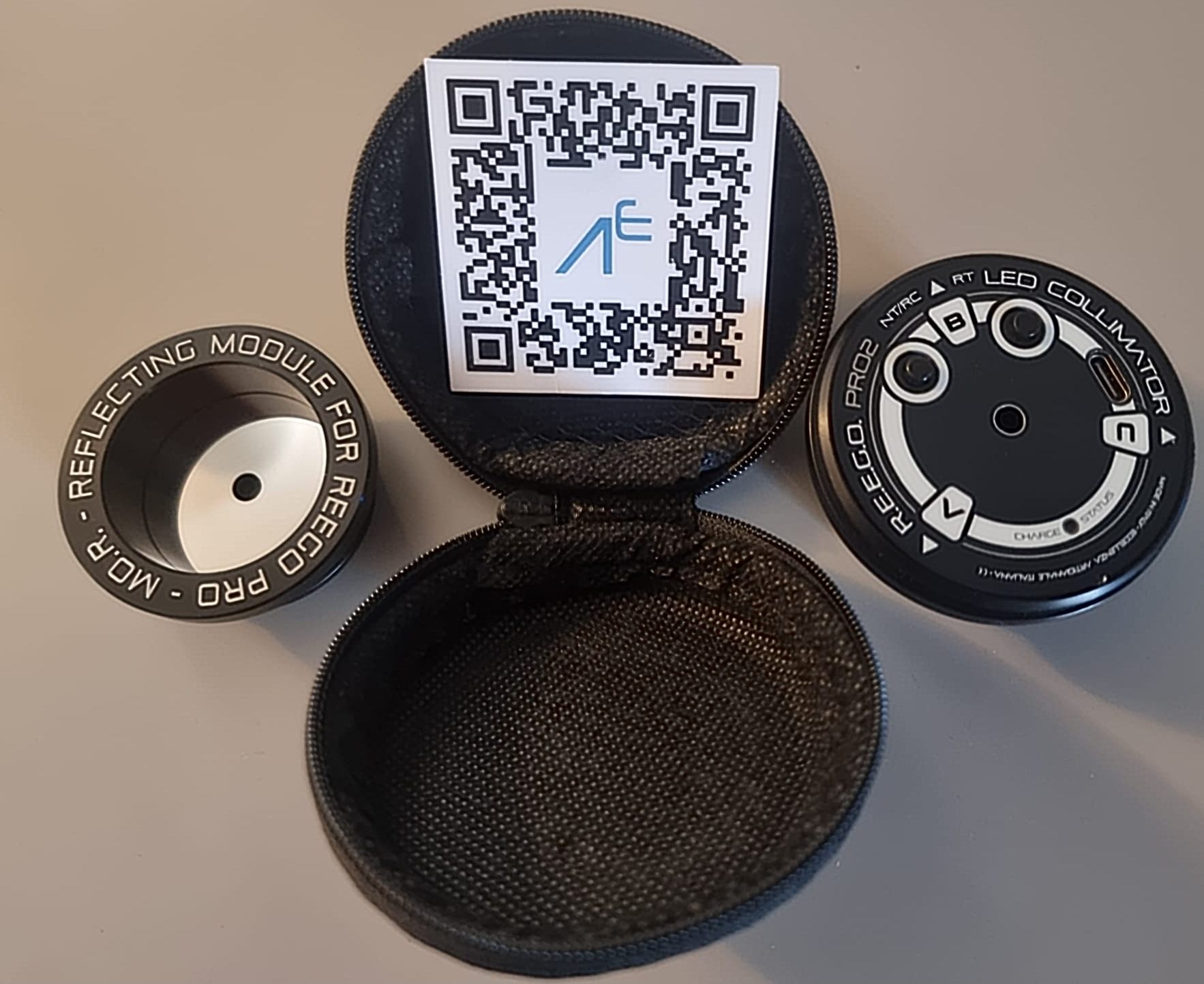 | 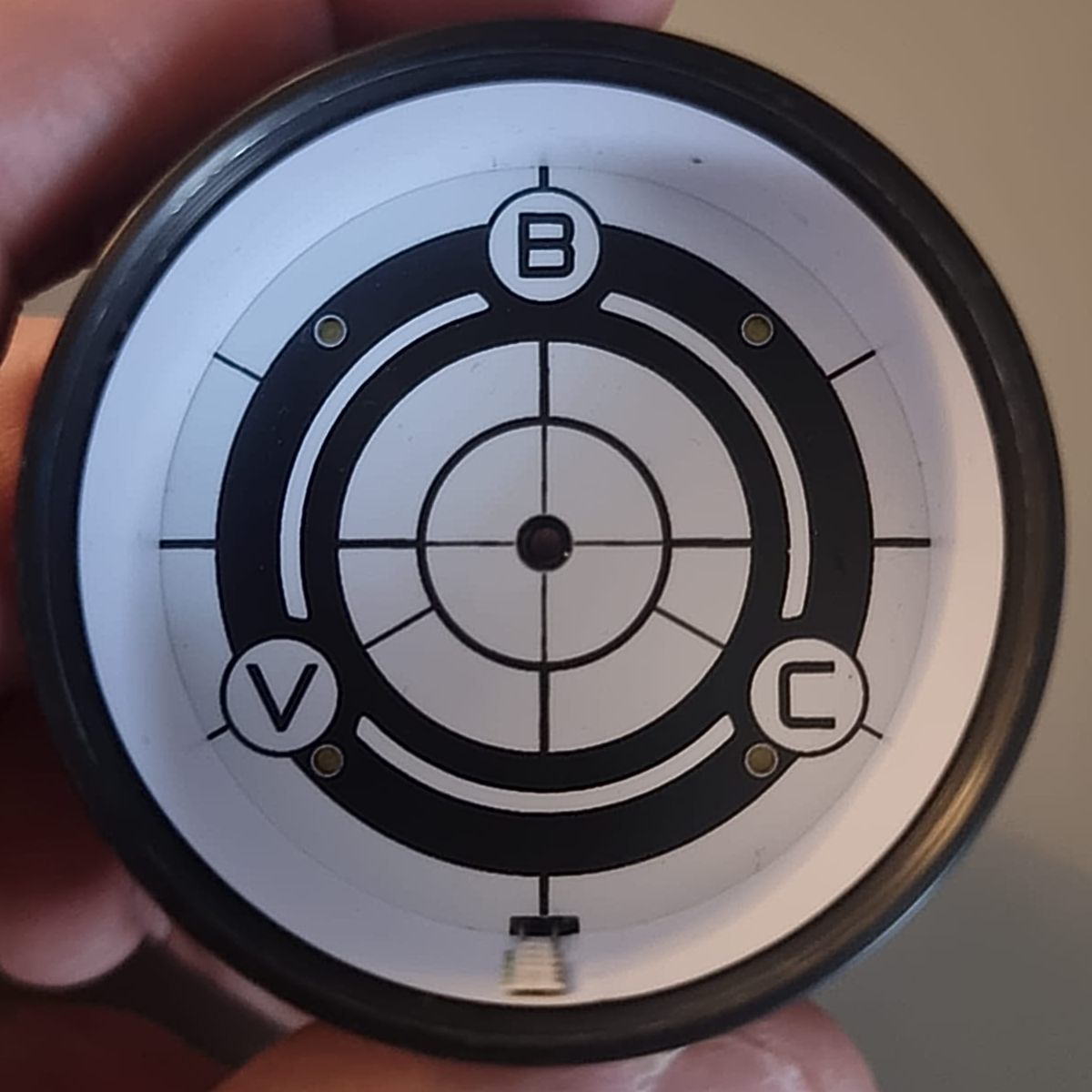 |
The REEGO Pro 2 packaging with the collimator on the right and the MO.R. reflection module on the left Through the QR code you can access the manuals for the collimation system | The inner part of the REEGO Pro 2 used for collimating the optics |
Practical experience: refractor and Newton
I used the REEGO in two different situations.
On my William Optics 110 FLT refractor I used it to check the alignment of the lenses, finding them perfectly aligned (Figure 1). It is a type of check that is difficult to do with the same confidence using traditional tools, and this alone justifies the interest; since my cell is not collimatable, mine was merely a check, but it is nice to do this test.
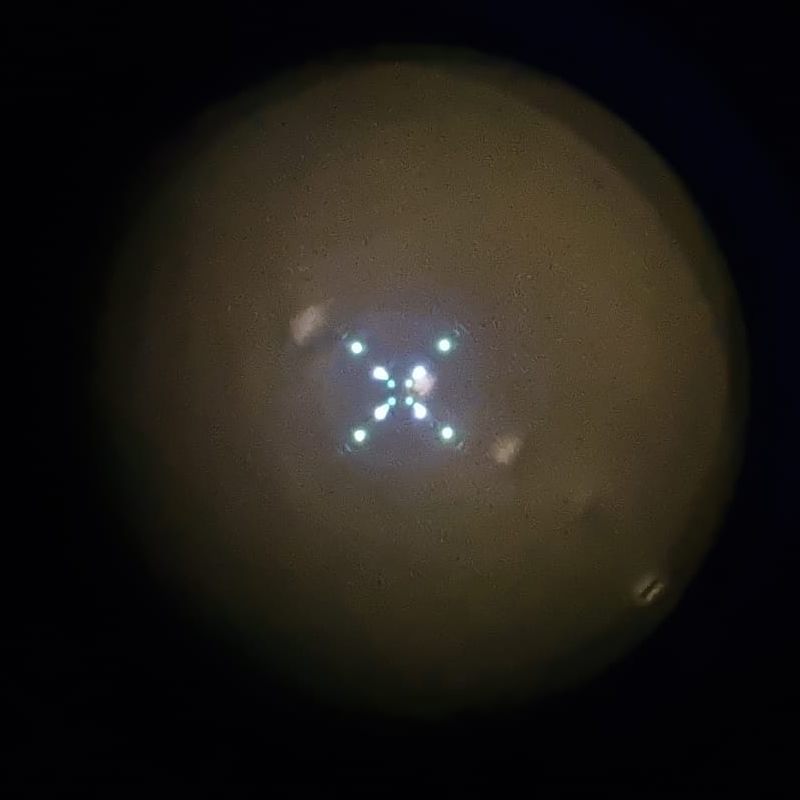 |
The image shown through the optics of the William Optics 110 FLT refractor Using the REEGO Pro 2 with the four white LEDs on |
The most demanding test, however, was collimating a Tecnosky Newton 250/1000 from scratch. Here the REEGO showed all its potential.
I was already familiar with the REEGO 1, so the coarse collimation phase with the REEGO 2 did not cause me any particular problems and I felt quite comfortable right away. As a general piece of advice, however, I still suggest a first coarse collimation with a laser, just to get everything “in the zone”, and then refining with the REEGO.
I must be honest, though: at first I had some difficulty with the MO.R.. Having read the manual rather superficially, I found myself quite disoriented, so much so that I actually managed – in practice – to miscollimate the instrument instead of improving it. Nothing dramatic, but it is fair to point it out.
Reading the manual again calmly and carefully (downloadable from the seller’s website), in particular the one dedicated to the MO.R., the operation became clear. At that point, within a short time, I really began to appreciate its speed of execution and ease of use. Once you understand what you are looking at, everything becomes logical and very reproducible.
The MO.R.: optional only on paper
Although the MO.R. is sold as an optional accessory, personally I believe it significantly improves the precision of the REEGO, to the point of considering it practically indispensable. It is thanks to the MO.R. that you can check (and if necessary correct) the offset of the secondary, a fundamental aspect especially in fast Newtonians. Without it the REEGO remains a valid tool, but with the MO.R. it makes a clear leap in quality.
Figure 2 shows what you observe when looking into the hole of the REEGO when it is coupled with the MO.R. attached.
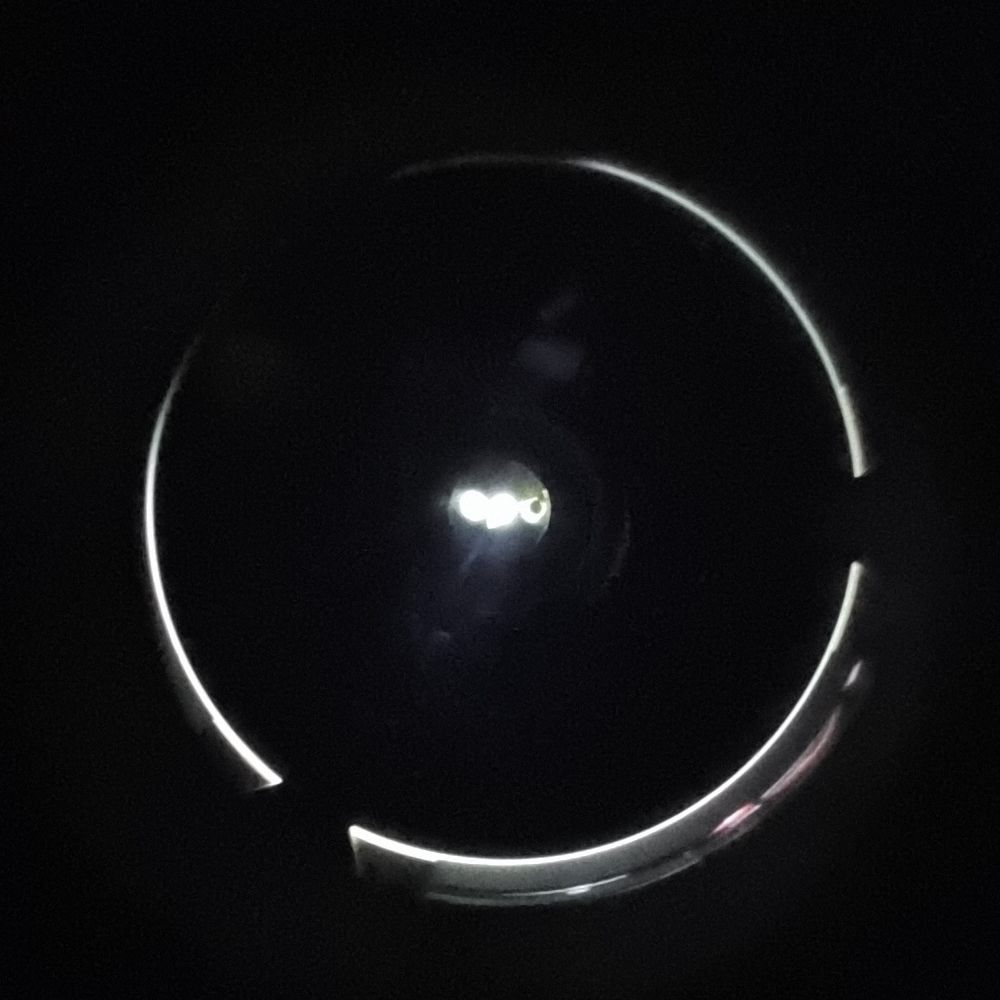 |
Figure 2: The view through the REEGO with the MO.R. inserted The outer circle is the light filtering in from the sides of the primary mirror, the dots in the center are the multiple reflections of the marker at the center of the mirror |
Figure 3 shows the detail of what you observe thanks to the MO.R. after having collimated the telescope with the laser and subsequently refined the alignment with the REEGO. In my case the central reference of the primary is translucent and is illuminated from behind with a torch. Because of a slight misalignment of the secondary, several reflections of the reference appear, visible to the right and left of the main image.
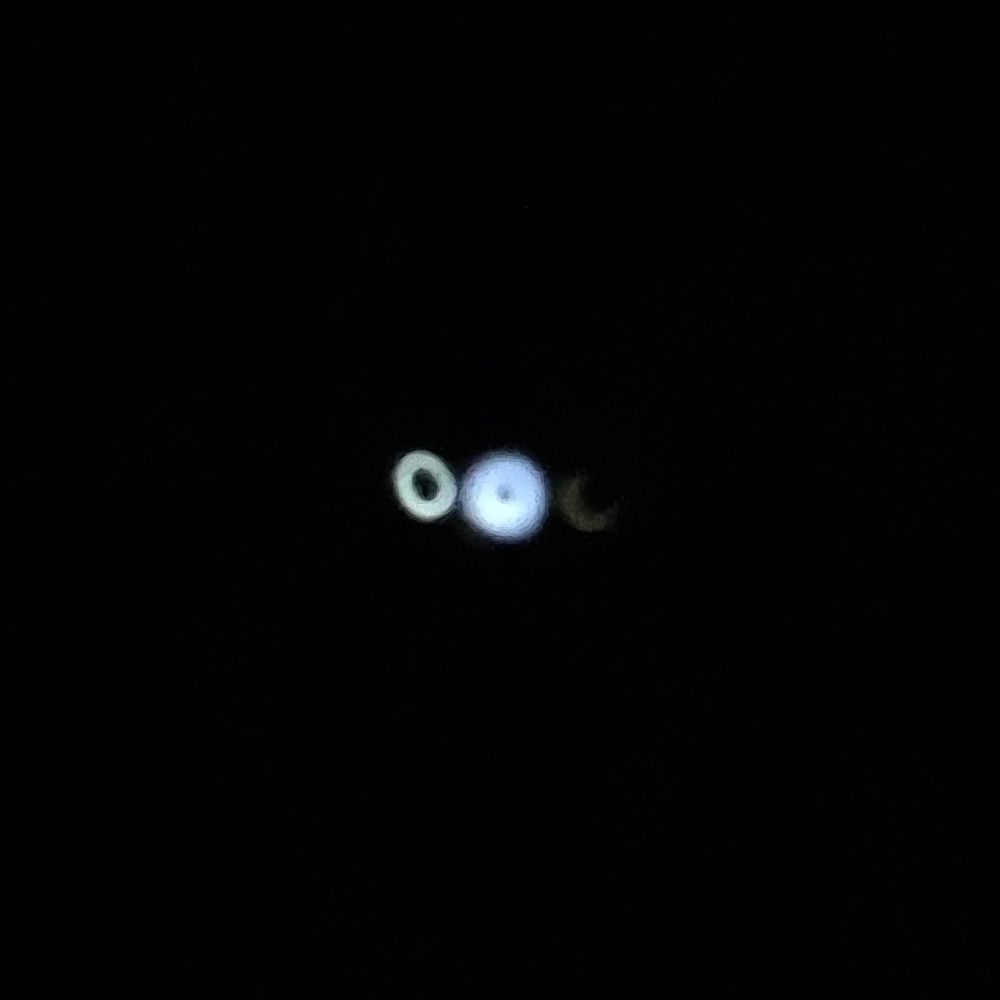 |
Figure 3: Detail of the multiple reflections of the marker in the case of a slightly miscollimated telescope. |
Acting on the collimation screws of the secondary, you observe how these reflections move symmetrically until they converge into a single image; at that point the telescope can be considered perfectly collimated (Figure 4).
 |
Figure 4: The view through the REEGO with the MO.R. inserted By adjusting the secondary mirror, the multiple reflections have overlapped at the center |
The difference between a collimation done exclusively with the laser and one subsequently refined with the REEGO Pro 2 System, as far as the shape of the stars is concerned, is barely noticeable (this is a purely qualitative assessment; I did not carry out accurate measurements on the frames). The difference is instead much more marked in the illuminated field: after collimation with the laser alone the vignetting appeared slightly asymmetrical, whereas after refining with the REEGO Pro 2 it became perfectly symmetrical, confirming the greater accuracy of the optical alignment.
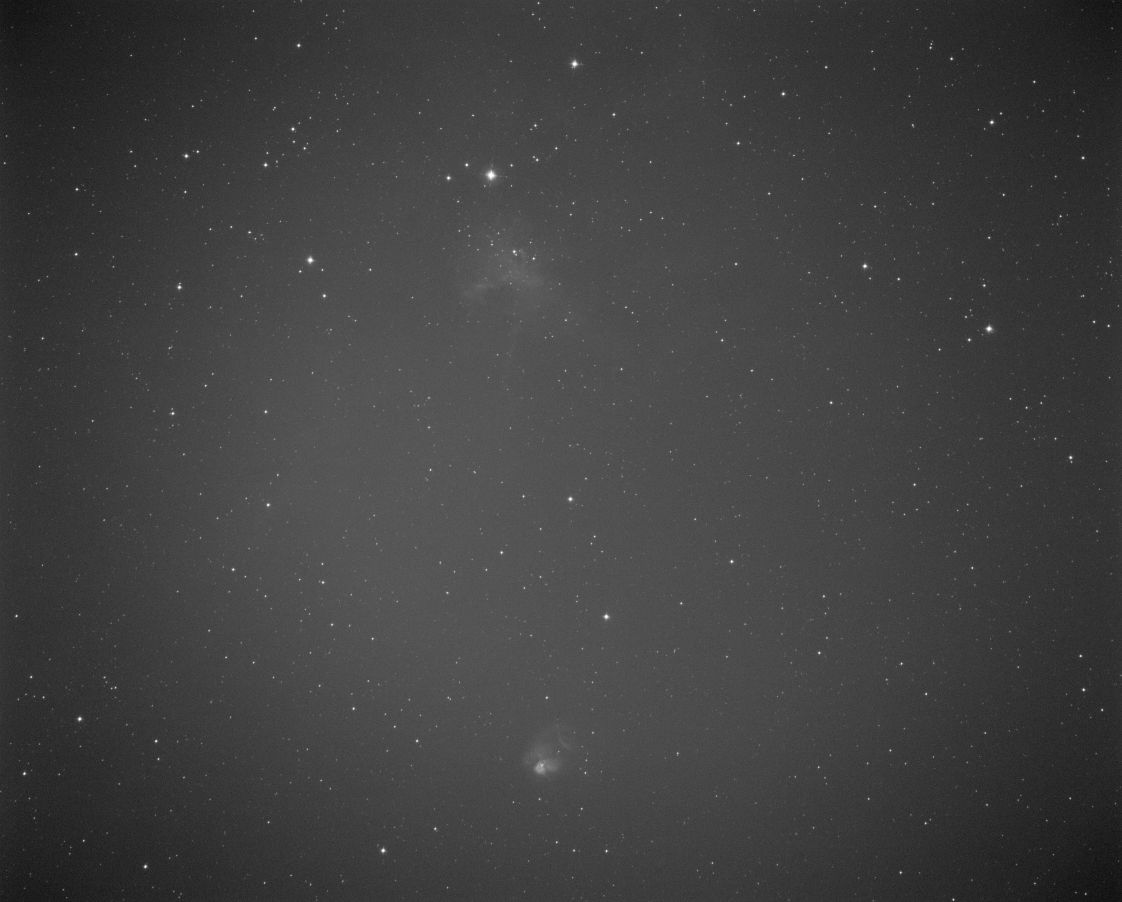 | 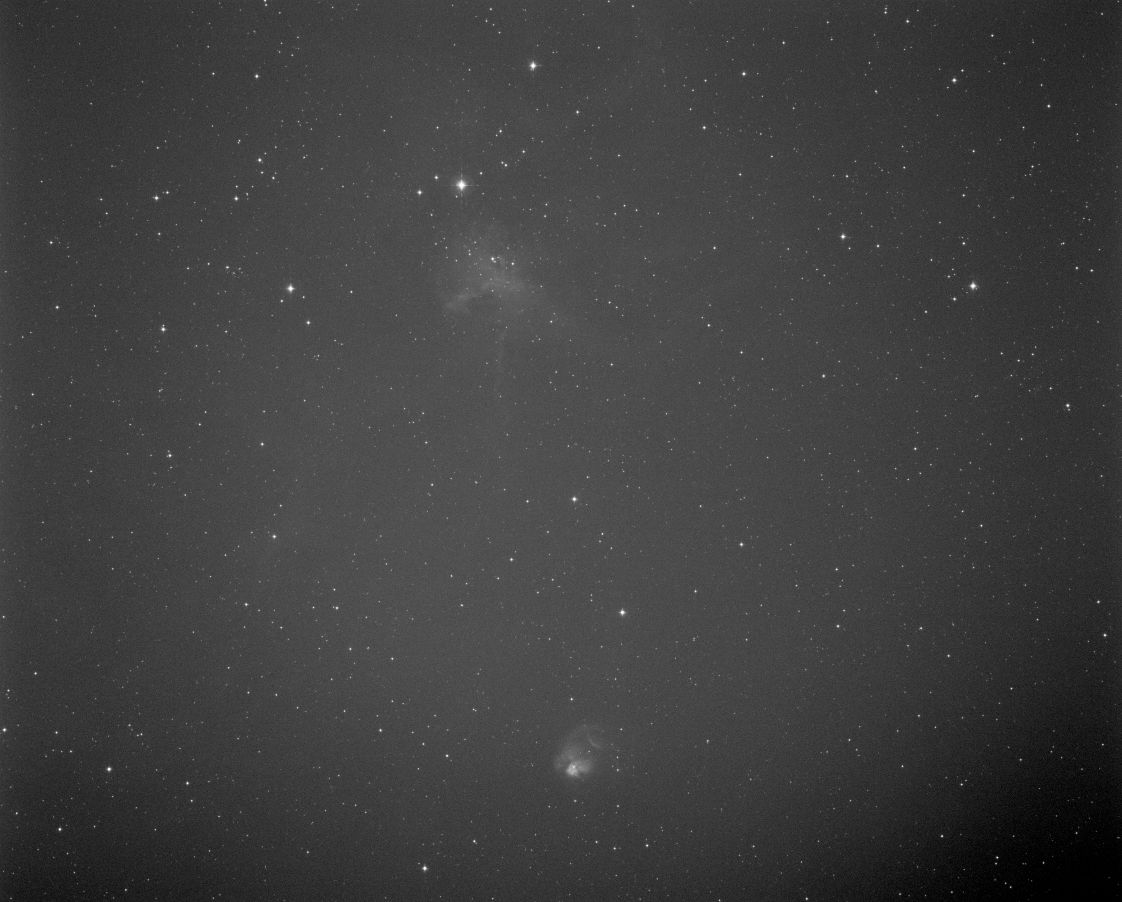 |
The vignetting AFTER the refinement | The vignetting BEFORE the refinement |
Limitations and practical tips
The only real shortcoming, which however is common to all geometric collimation systems, is the dependence on the orthogonality of the focuser and the stability of the drawtube into which the collimator is inserted: if the focuser flexes or is not well aligned, even the most precise instrument in the world cannot work miracles; however, in quality Newtons this eventuality is extremely remote.
A couple of practical tips that I strongly recommend during collimation:
- Keep the optical tube in a horizontal position. (as suggested in the manual) This does not affect the quality of the collimation, but it prevents any tools used to adjust the secondary from falling onto the primary. Just thinking about it… gives you the shivers.
- Fully retract the focuser drawtube before starting, bringing it to its stop. This minimizes flexure and mechanical play, improving the overall precision of the alignment
Conclusion
The REEGO Pro 2, especially when combined with the MO.R., is an extremely effective tool for those who want precise, repeatable and fast collimation while maintaining the “analog” feel. It requires a minimum of initial study (manual in hand!), but once understood it becomes fast, intuitive and reliable, allowing results that are hard to achieve with simpler tools.
Recommended for those who demand the best from their telescope, in particular in astrophotography and on medium and large diameter Newtons, which typically have parabolic primary mirrors that are far more sensitive to the effects of imprecise collimation.
For small Newtonians, equipped with a spherical primary and a secondary without offset, the REEGO Pro 2 without the MO.R. is probably more than sufficient to obtain a more than satisfactory collimation.
I thank TS Italia Astronomy for letting me try this very useful accessory.