
Page translated by Claude — switch to Italian to read the original article.
During my talk at Luca Fornaciari’s Astro Pub in January 2025 I had stated that I had never tried Newtonian telescopes for astrophotography.
A few days later, Giuliano Monti of Tecnosky contacted me to suggest I test their Newton 200/800 CARBON Series: a classic telescope with a 200 mm parabolic primary mirror and an 800 mm focal length, which provides an F/4 focal ratio.
Construction and materials
The telescope is entirely produced by GSO to exclusive Tecnosky specifications and, in the base configuration, includes a 2" hybrid Monorail/Rack-pinion focuser, support rings, a Losmandy bar and a Vixen bar (mounted on opposite sides of the rings) and a finder bracket.
The secondary mirror, with a diameter of 70 mm, produces a linear obstruction of 35%, corresponding to a light loss of about 12% compared to an equivalent unobstructed optic. The secondary support is the classic four-arm spider made with CNC machining: the supports, with their generous thickness, ensure total stability and give the images the characteristic “spikes”, so appreciated by enthusiasts of this type of instrument.
Collimation of the secondary is done by means of three Allen screws arranged at 120°.
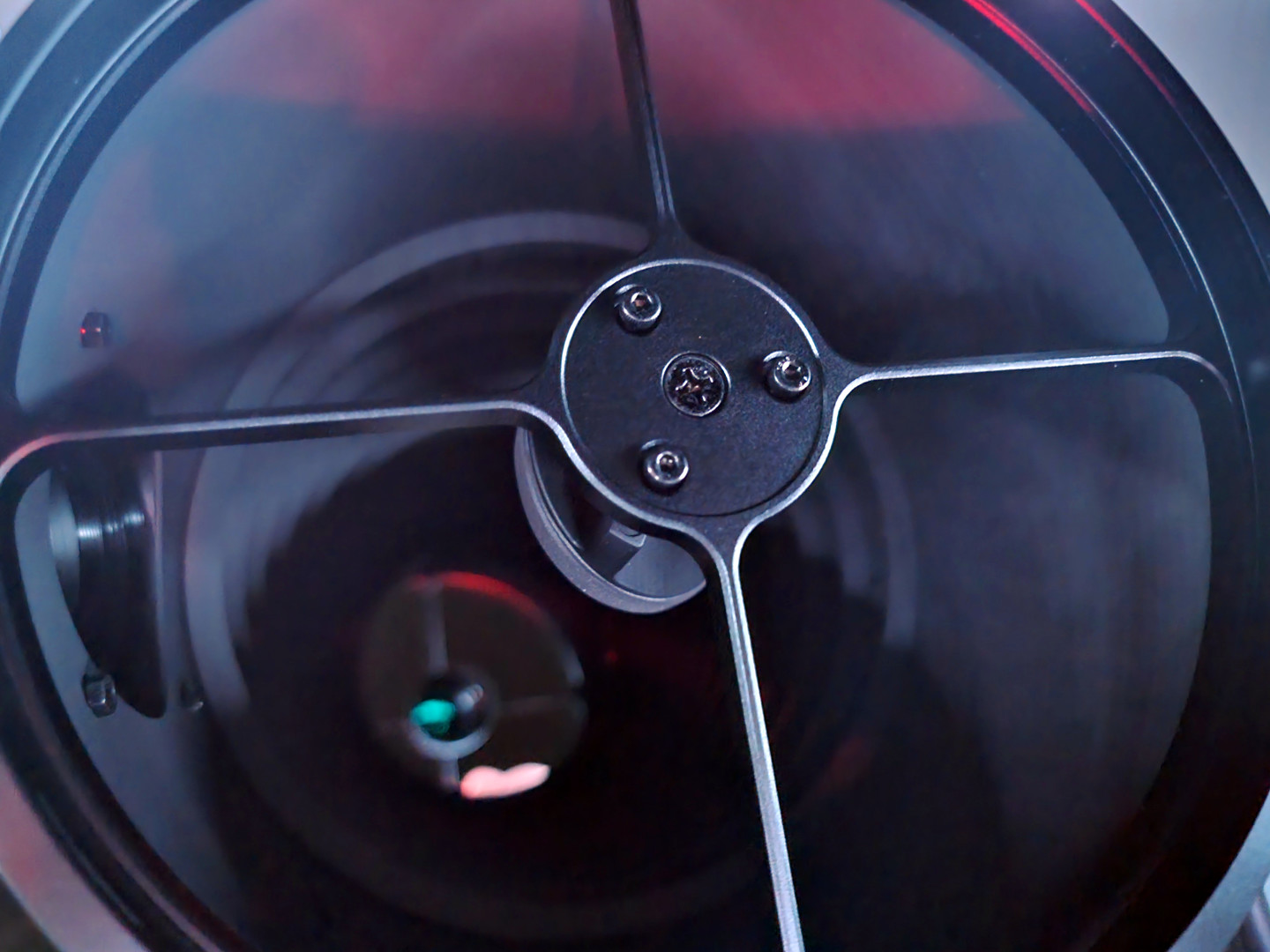
The primary cell, also CNC machined, has three support points near the circumference of the mirror, with cork spacers, and a simple but effective collimation system. It is also fitted with a plastic cap that completely closes the rear of the telescope.
The inside of the tube is fitted with numerous baffles and coated with a matte black paint, to minimize stray light.
My main concern was managing the weight of my Moravian G3 16200, equipped with an internal 5-position wheel and an external 7-position filter wheel, for a total weight of over 3 kg.
For this reason, Tecnosky provided me with the telescope with an upgrade: the Precision Focuser 2", capable of supporting up to 4 kg.
In addition to the telescope, I received two essential accessories for those who practice astrophotography:
1. ED 4-element Full Frame Coma Corrector
An indispensable component to correct the aberration typical of parabolic-mirror Newtonians, all the more evident the lower the focal ratio. The 4-element ED corrector ensures perfect correction up to Full Frame format (24x36 mm), without altering the native focal length; not owning such a large sensor, I was unable to verify the quality of the corrector up to its limits, but, as will be seen later, on the Moravian 16200 it performs excellently.
- Tecnosky-Vision AAF focuser motorization
Essential for automating imaging sessions and for fine, precise focus adjustment.
Another extremely interesting accessory is the self-centering locking system to be screwed onto the focuser: unfortunately, even though I received and mounted it, I was unable to test it properly because of my camera’s back-focus, which did not give me enough margin for focusing.
First impressions
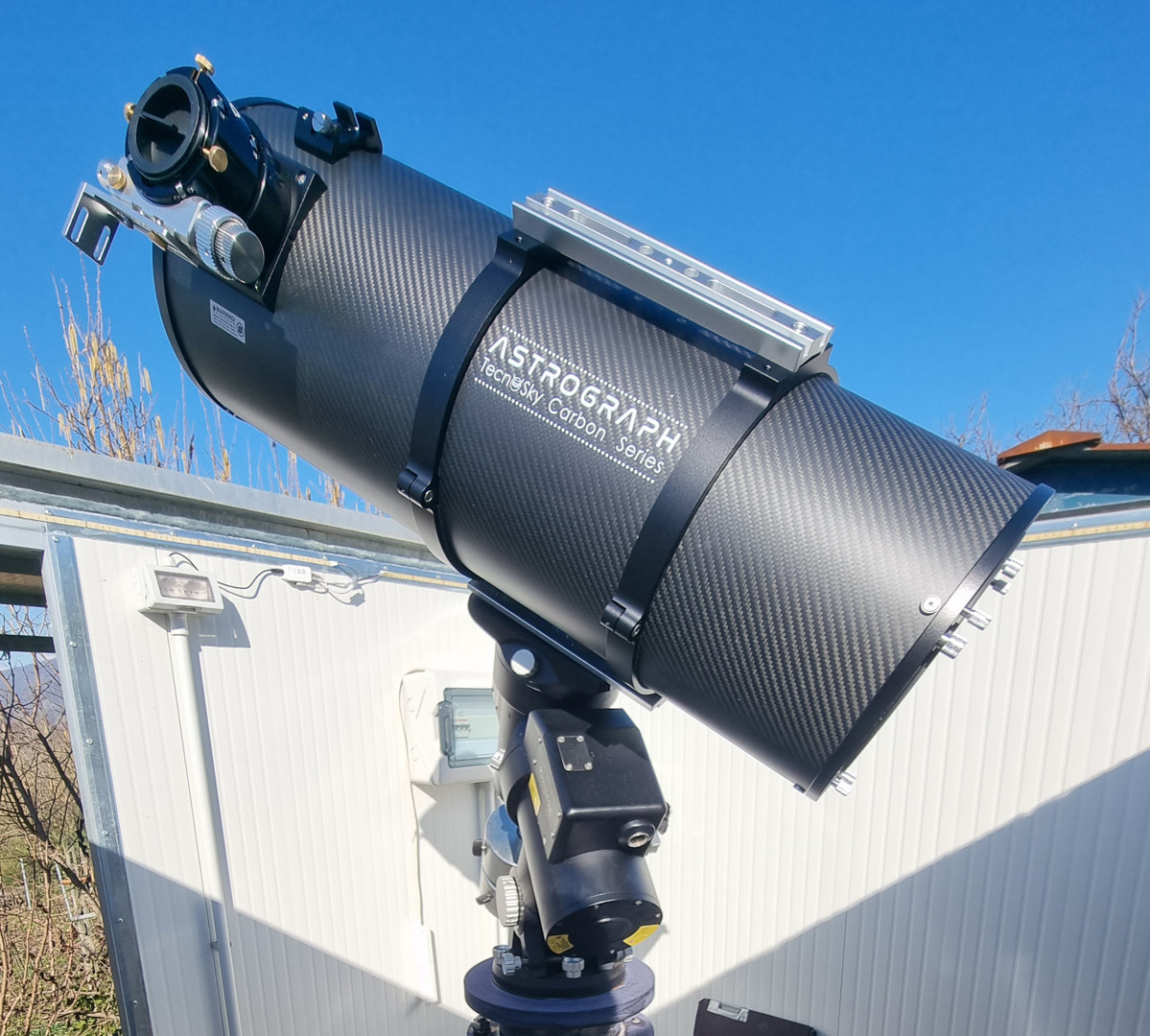
From the very first contact, the telescope proved surprisingly light (less than 7 kg) thanks to the carbon tube and the aluminum components, without sacrificing structural solidity.
The focuser supported my camera without problems, and the motorization handled the weight without difficulty, even in unfavorable positions.
The only aspect that could be improved concerns the plastic caps of the rear cell and the tube, which, although they do their job excellently, clash with the overall quality of the instrument.
Field tests
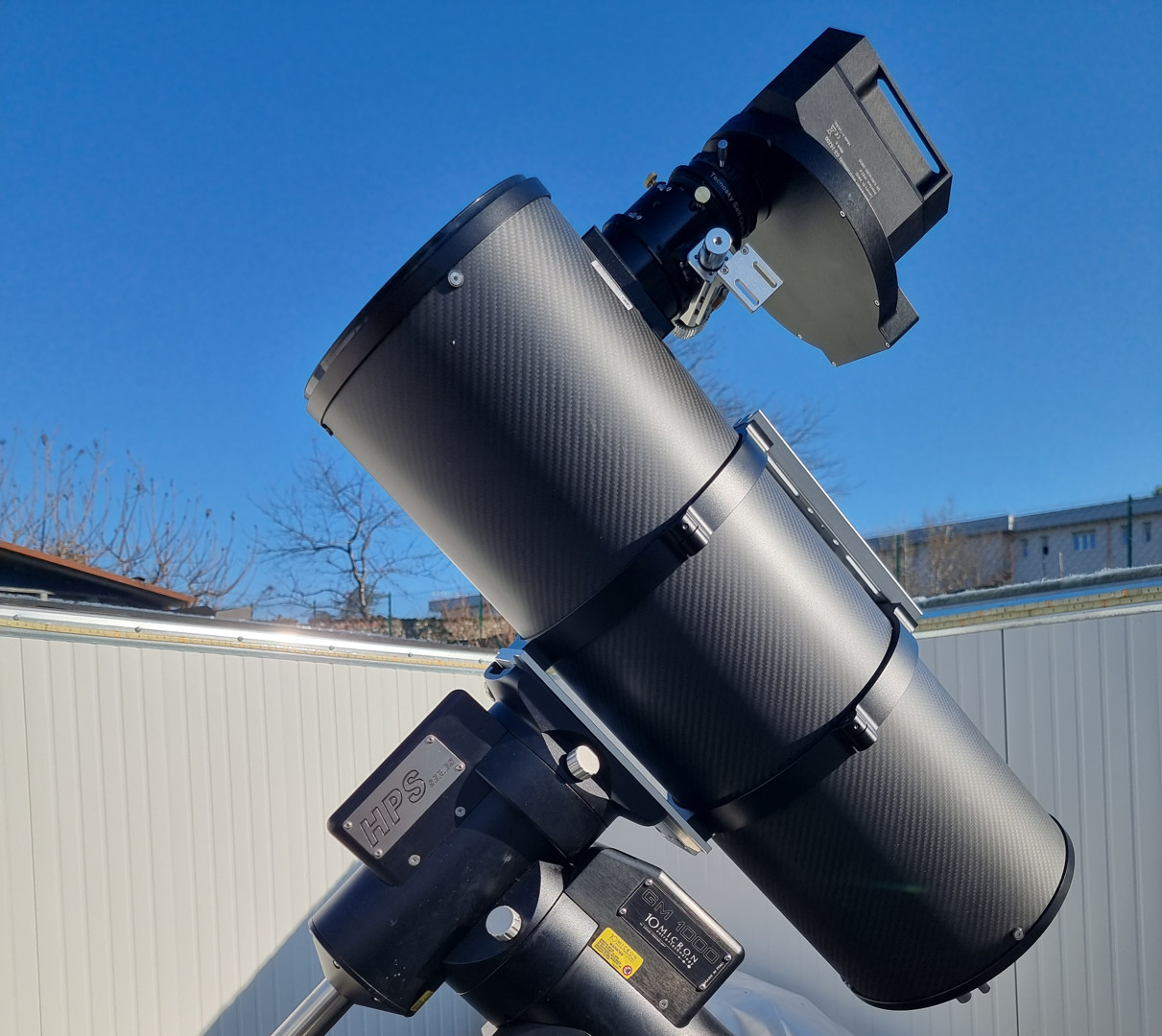
I mounted the Newton on my 10Micron GM1000, with the intention of taking advantage of the HPS system for long exposures without autoguiding. To obtain optimal results, it was essential that the optical train be free from excessive flexure, otherwise the mount’s model would not have been able to fully correct them, generating trailing after a few minutes of exposure.
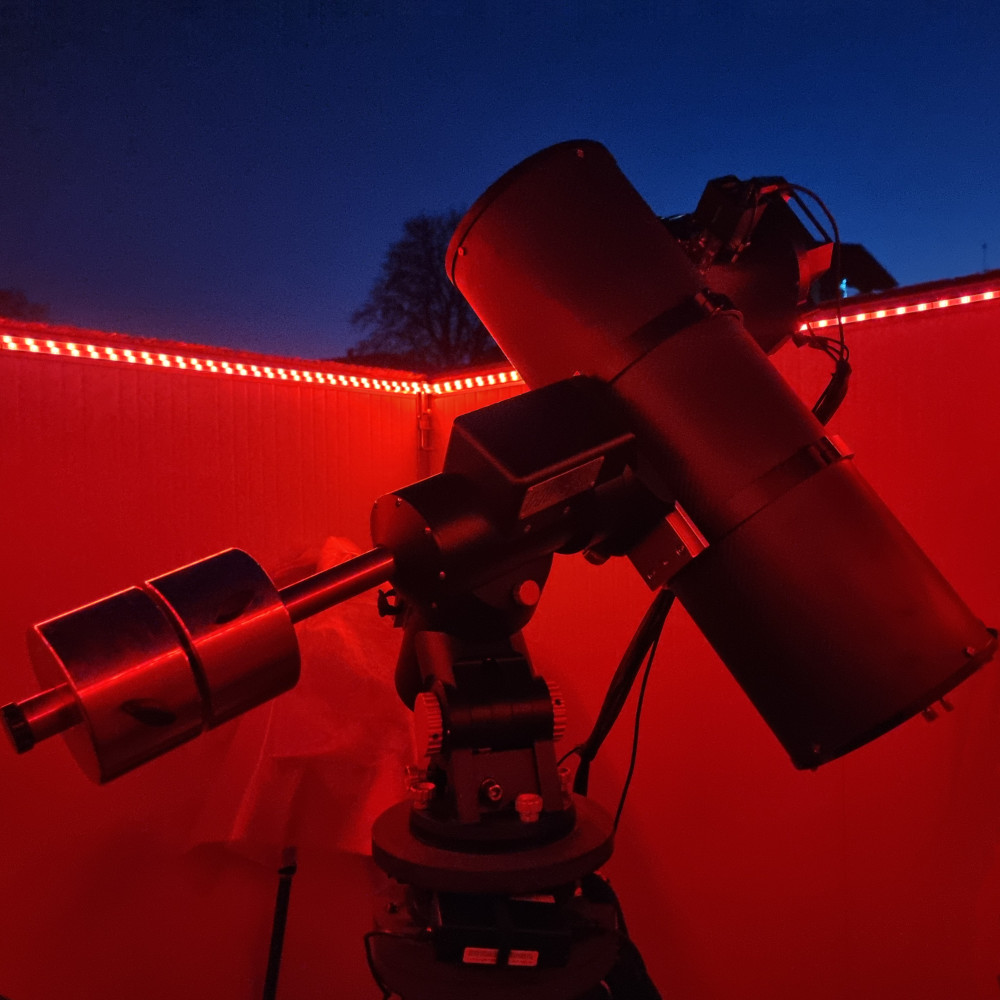
Because of the size of my camera, I had to set up the rig with the camera “cantilevered”, instead of the classic configuration with the camera at the bottom. This increased the lever arm, requiring 12 kg of counterweights.
The fundamental parameter to check when you want to use the HPS system is the RMS (the root mean square value of the pointing error) of the model created by the mount: if the RMS is less than 10 arcseconds the model is good and you can do without autoguiding; if it exceeds 15" the HPS system might not work properly.
After creating a 30-point model using N.I.N.A.’s 10Micron modeling plugin, the RMS obtained was just over 5", a sign of excellent rigidity of the setup, despite the weight and bulk of my CCD camera.
I then moved on to the imaging phase, but the very first result was rather disappointing: although focus was perfect and tracking was precise, all the stars in the center of the field looked “smeared” while those in the corners appeared considerably deformed.
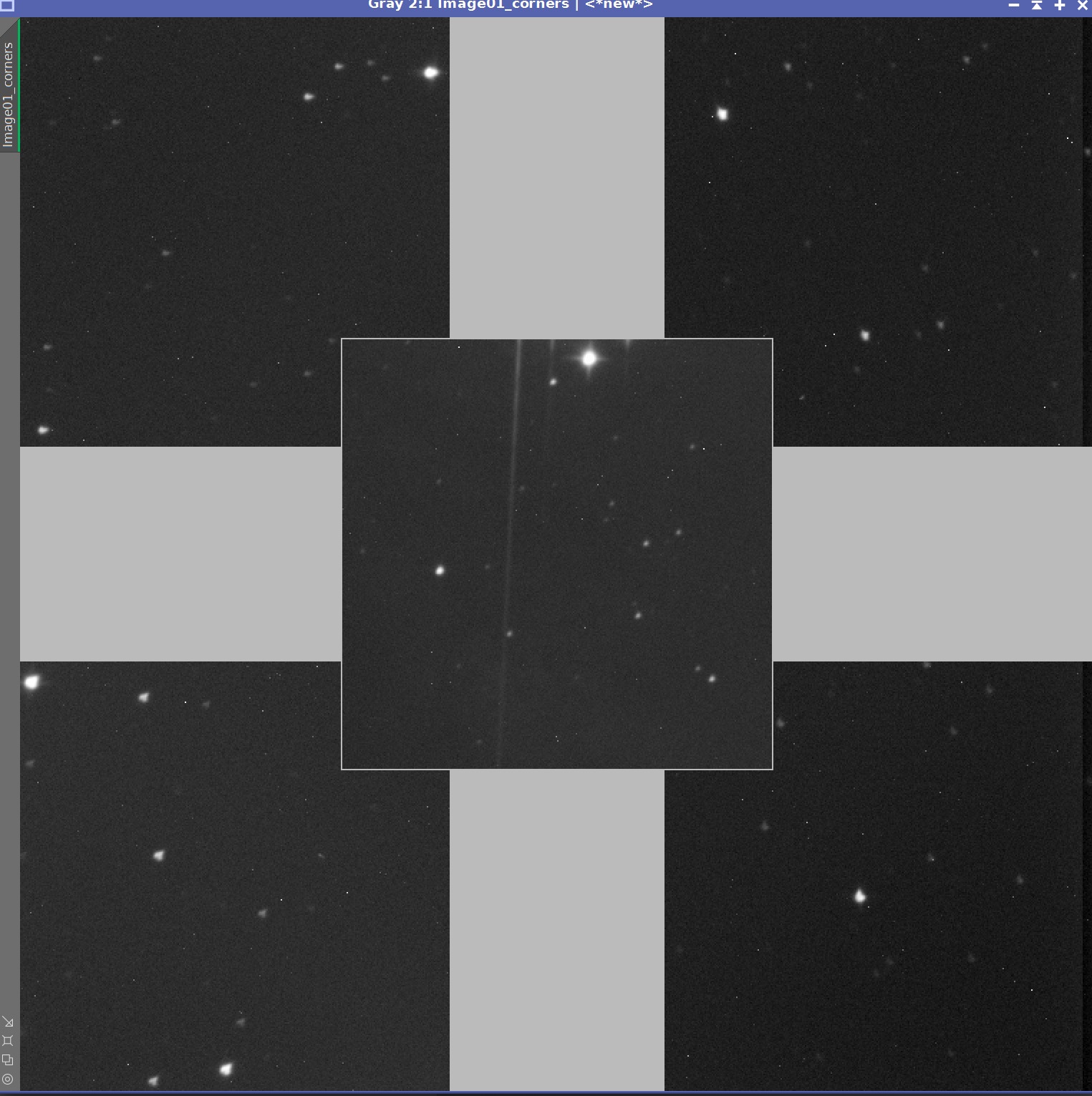
After an initial moment of bewilderment, however, I remembered that I was dealing with a Newton that, on top of that, had been delivered by an express courier: I had not checked the collimation before mounting the camera!
Doing a quick check with a laser collimator (also kindly provided by Tecnosky) I found a slight miscollimation.
After a quick adjustment, using the laser alone, the new image turned out to be perfect right up to the corners of the Moravian’s APS-H sensor (KAF-16200, 27.0x21.6 mm, 34.6 mm diagonal).
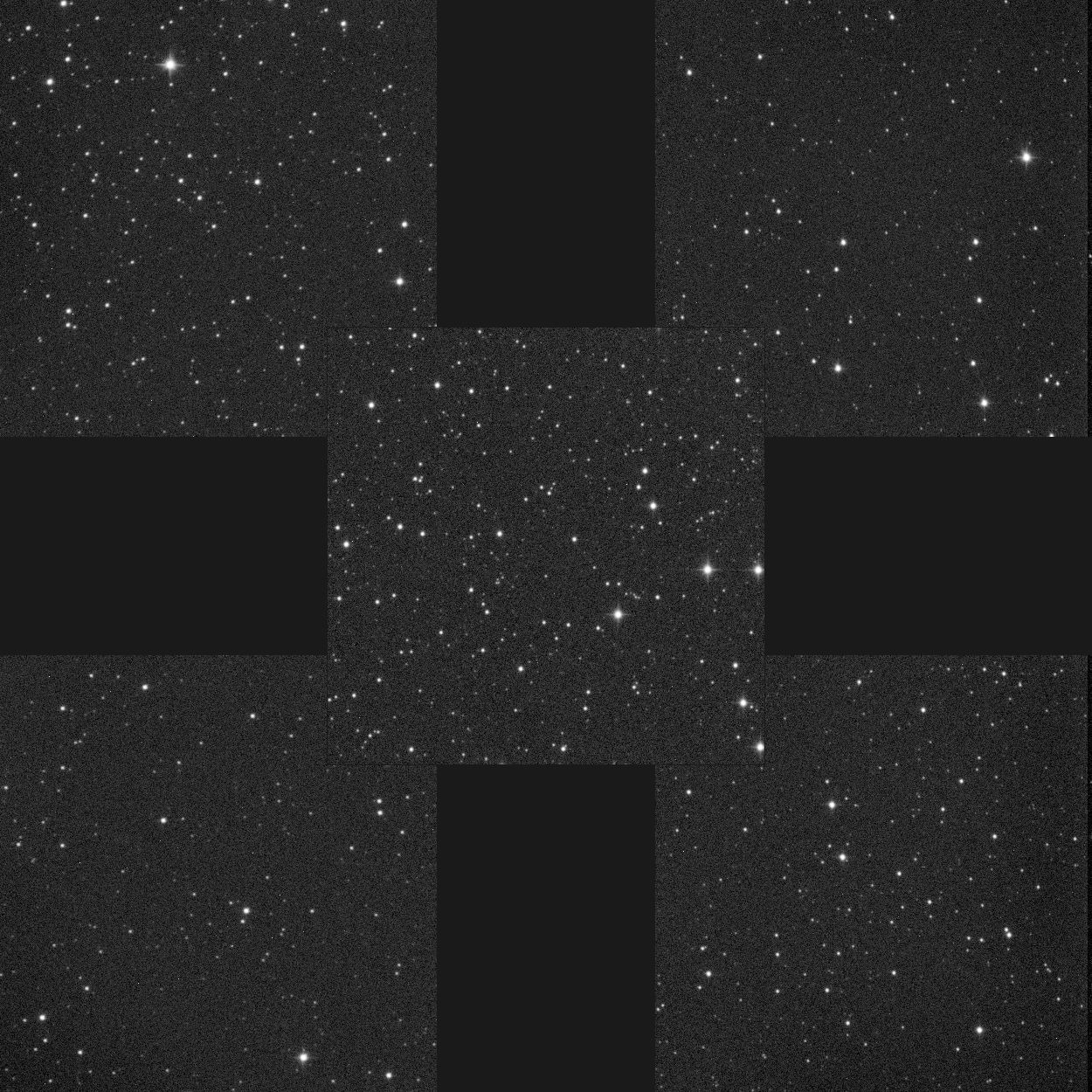
In all subsequent sessions I never had to re-collimate the telescope again, despite significant thermal excursions.
Despite the mediocre sky of the Lombardy plain, the images surprised me.
Used to working with my William Optics 110 FLT at F/5.8 and with the C9.25 at F/10, the F/4 of this Newton made itself felt immediately.
Here are some of the test shots I obtained: I remind you that the images were taken from a city sky on the outskirts of Brescia with an average SQM of 18.7.
 |  |
| M@H 35: Messier 35, NGC2158 and IC2157 | IC 410: Narrow Band Tadpoles |
 |  |
| NGC 2237: The rosette from Misty Lombardy | M@H 81-82: The Ursa Major Triplet, M81 M82 NGC3077 |
Analyzing the flat fields, I measured a light fall-off of 40% across the 34.6 mm sensor diagonal. This value, although significant, is manageable during calibration.
Acknowledgments and Conclusions
I wish to express my most sincere thanks to Giuliano Monti and the whole Tecnosky team for giving me the opportunity to test their Tecnosky 200/800 CARBON Series Newton. I found a high-quality, very interesting instrument capable of offering excellent performance in deep sky photography.
It proved to be an excellent instrument for medium-field deep sky photography: compact, light but sturdy, with no evident flexure even with heavy cameras.
The only point to consider is the vignetting, with a light fall-off of 40% probably due to the 2" focuser: for cameras larger than APS-C format it would be preferable to have a 2.5" or even 3" diameter.
However, since vignetting is perfectly recoverable during calibration, I find this a completely manageable aspect.
I think the quality/price ratio of this instrument is unbeatable.
Did I like it? I have just ordered its big brother, the 250/1000: you be the judge.